
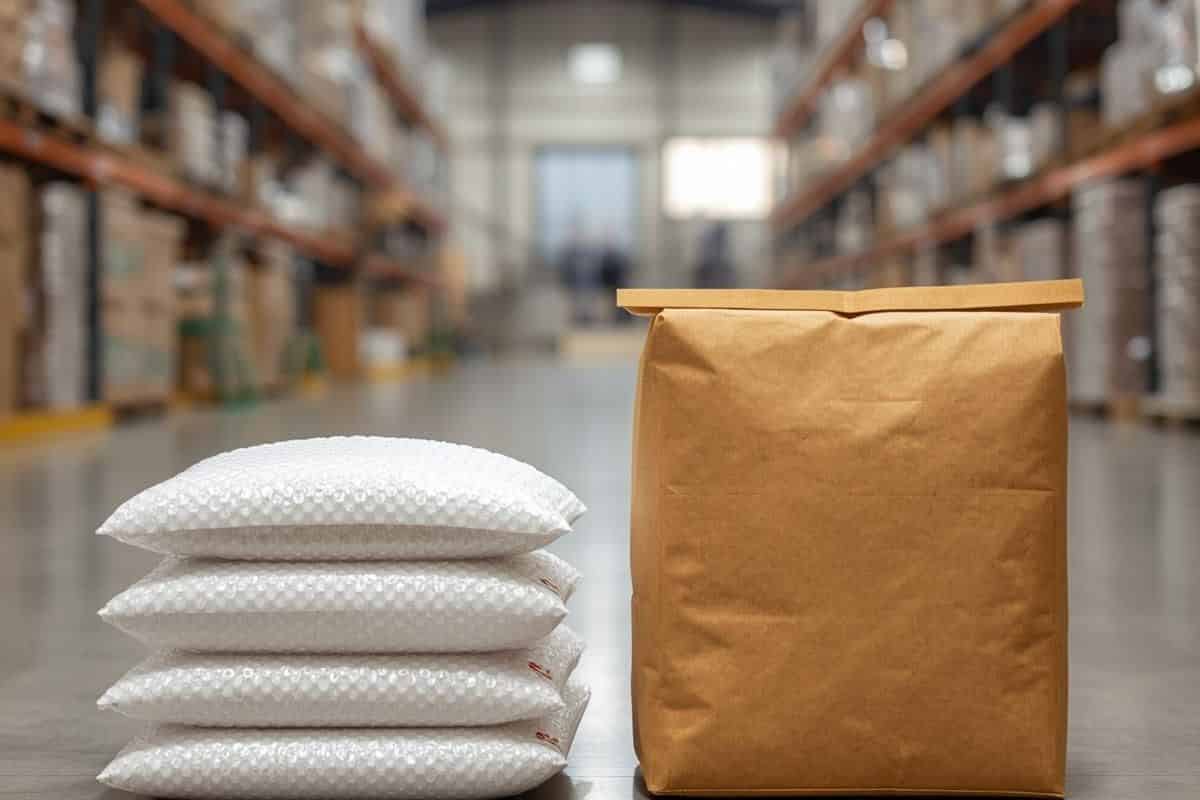
Most brands don’t know how important it is to choose the appropriate mailer. The global mailer packaging industry is worth $37.22 billion in 2025 and is expected to grow to $56.97 billion by 2032. This means that businesses are sending more products than ever before, and every tiny packaging choice affects the cost, safety, environmental impact, and customer experience. That’s why the discussion over bubble mailers and padded mailers is really about knowing what each one really does.
We go over the most important variations in weight, durability, rigidity, and shipping cost in this guide. We also answer popular queries like “How much does a bubble mailer weigh?” “How much does a poly mailer weigh?” and “When does a flat rate padded mailer make sense?”
Quick Summary Up Front
- Bubble mailers = lighter, cheaper to ship, water resistant, great for soft goods and low-fragility items.
- Padded mailers (paper-padded) = stiffer, often easier to recycle / compost in some systems, better for items that need rigidity and abrasion resistance.
Understanding Bubble Mailers: The Lightweight Champion
Those satisfying-to-pop envelopes that have saved countless products from shipping disasters.
What Are Bubble Mailers?
Bubble mailers are envelopes that have bubble wrap within them. It’s a simple idea, yet it works quite well. The exterior layer is usually made of polyplastic, like our LDPE or HDPE alternatives at Elements Branding Solutions. The inner layer has those famous air-filled bubbles that make it soft.
The cushioned mailers market, which includes bubble mailers, is predicted to increase at a CAGR of 6.69% during the next few years.
Why Businesses Love Bubble Mailers
Cost-Effective: Bubble mailers are usually cheaper than padded mailers. When your margins are thin (and who isn’t?), every penny matters. Making plastic is easier and cheaper than making paper.
Excellent for Specific Products – Bubble mailers excel at protecting items like:
- Clothing and apparel
- Books and magazines
- Small electronics (phone cases, accessories)
- Non-fragile items that need basic protection
- Cosmetics and personal care products
Compact Storage: A case of 100 bubble mailers (8.5″ x 10.75″) weighs only 5 pounds, and you can fit 8,000 of them on a single pallet. This efficient use of space means lower costs for the warehouse and easier work for your fulfillment crew.
The Downsides of Bubble Mailers
Less Durable – The bubbles make the material softer, but the outside poly substance is easier to puncture than cushioned paper.
Environmental Concerns – Most bubble mailers are comprised of plastic, which doesn’t break down in nature. This is important to brands and customers who care about the environment. But at Elements Branding Solutions, we’re seeing more and more people want recyclable choices. Our LDPE and HDPE bubble mailers can be dropped off at grocery stores to be recycled.
Limited Rigidity – If you require a mailer that won’t bend at all, bubble mailers might not be enough. It’s in their nature to be flexible.
Understanding Padded Mailers: The Heavy-Duty Protector
What Are Padded Mailers?
Padded mailers, which are also called cushioned mailers, have a layer of cushioning material, usually recycled paper or foam, between two layers of paper on the outside. Compared to bubble mailers, they are stronger, stiffer, and provide better protection.
The global market for padded mailers will be worth $3.8 billion in 2025 and $7.4 billion in 2035, with a compound annual growth rate (CAGR) of 6.9%. That’s almost twice as much in ten years, thanks to the expansion of e-commerce and the need for safe delivery options.
Why Businesses Choose Padded Mailers
Superior Protection – Padded envelopes are the best way to protect fragile things that need more than just simple padding. The padding layer absorbs shocks more than just bubble wrap; therefore, it’s great for:
- Glassware and ceramics
- Jewelry and watches
- Sensitive electronics
- Medical devices
- Premium products requiring extra care
Greater Rigidity – Padded mailers are less likely to bend than bubble mailers. Padded mailers keep things like photos, certificates, and other things that shouldn’t fold firmly while they are being shipped.
Eco-Friendly Options – Many padded mailers are constructed from 100% recycled materials (ours at Elements Branding Solutions are manufactured from 25% post-consumer recycled materials). All curbside recycling programs in the US will take them, which makes it easy for customers to get rid of them.
Premium Presentation – The Kraft paper outside makes padded mailers look more natural and earthy. Some buyers think this style is linked to sustainability and quality, which might improve how people see your business.
Better for Heavy Items – The strengthened construction makes it easier to carry heavy items than regular bubble mailers.
The Downsides of Padded Mailers
Weight and Shipping Costs – A padded mailer that weighs 2.2 ounces compared to a bubble mailer that weighs 0.8 ounces may not seem like a big deal, but when you send thousands of packages, the shipping costs go up a lot.
Storage Space – A case of 100 padded mailers weighs 20 pounds, whereas a case of bubble mailers weighs only 5 pounds. You can only fit 2,400 padded mailers on a pallet, while you can fit 8,000 bubble mailers. This means that it costs more to store and move the mailers to your building.
Higher Cost – Padded mailers usually cost more per unit than bubble mailers since they use more materials and take longer to make. This extra might not be worth it for all products for organizations that are careful with their money.
Landfill Concerns – If padded mailers end up in landfills instead of being recycled, they have a worse effect on the environment than bubble mailers. In landfills, recycled paper can leech poisons, and as it breaks down, it emits methane, a greenhouse gas that is 84 times more powerful than carbon dioxide in its first 20 years.
What’s the Actual Difference?
1) Construction & feel
- Bubble mailer = an outer plastic/poly film shell with an inner bubble-foil or air-cushion liner. Flexible, weatherproof, very light.
- Padded mailer = usually made of kraft or paper on the outside and cushioned paper honeycomb or recycled fiber on the inside. It may also have a paper or thin film lining. It feels more “boxy” and stiff.
2) Protection style
- Bubble protects by local cushioning (good for shock/impact).
- Padded protects by both cushion and rigidity — it resists bending and provides better crush protection for flat items.
3) Environmental tradeoffs
- Padded paper mailers are frequently better for recycling and composting at the curb (where facilities are available).
- Bubble and poly mailers are lighter (they take up less space when being shipped) and more and more of them have PCR (post-consumer recycled) content. The outcome of the lifetime relies on the recycling infrastructure in your area.
Poly Mailer Vs Bubble Mailer: Where Each Wins
When to pick a poly (non-padded) mailer
- Shipping soft goods (t-shirts, hosiery) that don’t need extra cushion.
- You want the lightest possible pack to cut postage.
- Weather resistance (poly protects from rain and moisture).
When to pick a bubble mailer
- Small electronics, fragile accessories, and prints that need light shock protection.
- You want a low-weight cushion without compromising water resistance.
- Reusability is a plus — many bubble mailers reseal well.
When to pick a padded paper mailer
- Items that need rigidity (documents, thin framed art, small flat electronics) so the pack won’t bend.
- Brands prioritizing curbside recyclability or compostability (check local rules).
- When presentation (kraft look) matters, and the product still needs cushioning.
Practical Checklist: Which Mailer to Choose
- Product fragility
- Fragile or brittle → padded mailer or bubble mailer (test drop results).
- Fragile or brittle → padded mailer or bubble mailer (test drop results).
- Need for rigidity
- Must not bend → padded mailer (paper) or add a rigid card inside bubble mailer.
- Must not bend → padded mailer (paper) or add a rigid card inside bubble mailer.
- Shipping cost sensitivity
- Lowest postage priority → poly mailer (non-padded) or bubble mailer (lighter).
- Lowest postage priority → poly mailer (non-padded) or bubble mailer (lighter).
- Sustainability goal
- Want curbside recycling/compost → paper padded (verify local programs).
- Want curbside recycling/compost → paper padded (verify local programs).
- Weather resistance
- Must resist moisture → poly or bubble mailer.
- Must resist moisture → poly or bubble mailer.
- Branding & unboxing
- Premium look + tactile → paper padded (kraft finish) or custom-printed bubble (but MOQ can be high).
Quick Packing Tips to Avoid Damage (And Returns)
- Right-size the mailer — avoid excessive movement.
- Add a rigid insert (chipboard) inside bubble mailers for flat items.
- Use a second seal for returns if you expect reverse logistics.
- Test: run a small A/B between bubble and padded mailers on 200 orders to measure damage rate, returns, and shipping cost difference.
Making the Right Choice for Your Business with Elements Branding Solutions
Poly or bubble mailers save space and money when you ship a lot of soft clothes. Padded paper mailers are frequently better at protecting flat, fragile, or presentation-sensitive objects, but they cost more and weigh more. The best choice is to set protection, shipping, and sustainability goals for each SKU.
Want help with a low-cost A/B packaging pilot (samples, cost comparisons, drop tests)? We can quickly put together a sample pack and test it in the real world for your best-selling items.
FAQs
It depends on size, but a common 8.5″ × 10.75″ bubble mailer weighs about 0.8 oz (≈23 g). Larger bubble mailers weigh more, but bubble mailers remain lighter than comparable padded paper mailers in most cases.
A thin poly mailer for apparel typically weighs ~0.5–1.5 oz (15–45 g) depending on thickness and size. Heavier-duty poly or larger sizes increase weight but usually stay lighter than paper-padded alternatives.
Choose poly mailers for the cheapest, lightest option (soft goods). Choose bubble mailers when you need lightweight cushioning and moisture resistance. For rigidity and curbside recyclability, consider padded paper mailers.
A flat-rate padded mailer is a carrier product where postage is a fixed rate (within size limits). Use it if that flat rate is cheaper than calculating actual weight or dimensional charges for your specific SKU and shipping zones.
Many bubble/poly mailers can be recycled via drop-off programs (grocery bag bins), but are often not accepted curbside. Check local recycling rules and prefer mailers with PCR content where possible.
Padded paper mailers can be easier to recycle or compost (where facilities exist), but their higher material weight can sometimes mean a larger transport footprint — evaluate by life-cycle and local disposal options.
